
Dog Whistle Training: What Actually Works (My Experience With Koffie)
By Julia Perez
Dog Trainer, Behaviorist & Dog Mom to Koffie
If you have ever stood at the edge of a windy field shouting your dog’s name until your voice cracks—while your dog happily ignores you to sniff a gopher hole fifty yards away—you’ll understand why I finally put a lanyard around my neck.
My 2-year-old Black Lab, Koffie, has a solid recall in our backyard. Out on a wide-open trail with wind blowing and squirrels darting through the brush, though, my normal voice gets swallowed up fast. The louder I yelled, the more frustrated I sounded, and dogs are terrible at coming back to an owner who sounds annoyed.
Switching to a dog whistle completely changed our off-leash walks.
Because I’m a dog trainer, clients ask me about whistles all the time. Usually, they’ve seen an ad online promising that a “silent” whistle will magically freeze a barking dog in its tracks or instantly fix bad manners. I always have to break the news gently: a whistle isn’t magic, and it definitely isn’t a remote control. It’s just a really clear, consistent way to talk to your dog.
A quick note before we jump in: I’m sharing my hands-on training experience with Koffie and my clients, not giving medical advice as a veterinarian. If your dog ever seems startled, fearful, or shows signs of ear discomfort around high-pitched sounds, stop using the whistle and check in with your local clinic.

The Biggest Myth: It’s Not a Magic “Mute” Button
Let’s get this out of the way first, because it’s the number one reason people buy a whistle and toss it in a junk drawer a week later.
A lot of people buy an ultrasonic (silent) whistle hoping that one sharp blast will annoy their dog into stopping a dog barking fit. In reality, blowing a high-pitched whistle at a barking dog without any training usually does one of two things: either the dog completely ignores it, or the sharp noise startles them, spikes their adrenaline, and makes them bark even harder.
A dog whistle doesn’t work because it’s annoying. It works because it is neutral.
When you yell “Koffie, come!” across a park, your voice carries your stress, your breathlessness, and your frustration. A whistle sounds the exact same every single time—calm, crisp, and loud enough to cut through wind and traffic noise from a quarter-mile away.
Silent vs. Standard: Which Whistle Actually Makes Sense?
Dogs have incredible hearing. While human hearing generally tops out around 20,000 Hz, dogs can hear frequencies up to around 45,000 Hz. That’s how “silent” ultrasonic whistles work—you twist a little screw to adjust the pitch into a range that sounds like a faint hiss of air to you, but rings loud and clear to your dog.
As the American Kennel Club (AKC) notes, both silent and audible whistles can be effective, but as a trainer, I actually prefer a standard, low-pitch audible dog whistle (like a classic pea-less gun dog whistle) for everyday recall.
Why? Because with a silent whistle, I can’t always tell if the little screw has shifted in my pocket, or if I’m blowing it weakly when I’m out of breath. With a standard whistle, I know for a fact it’s working, and it’s still gentle enough not to hurt my own ears.
How I Taught Koffie to Love the Whistle
A whistle means absolutely nothing to a dog until you “charge” it—meaning you pair the sound with something amazing. It’s the exact same positive-reinforcement foundation I use when teaching clients how to stop puppy biting feet when walking: you build a clear, rewarding association first.
Here is the exact three-step process I used with Koffie:
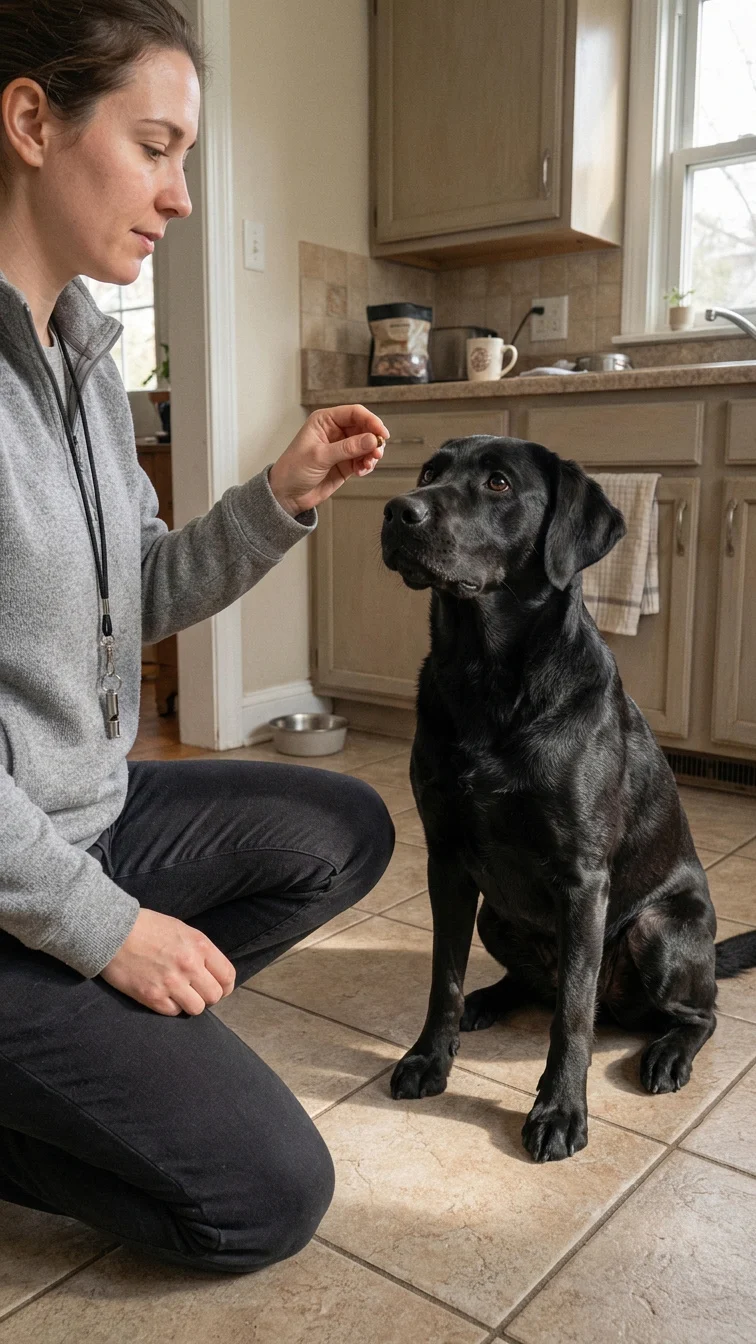
1. The Kitchen “Charge” (Days 1–3)
I started right in our kitchen with zero distractions and a bowl of Koffie’s absolute favorite treats—tiny pieces of boiled chicken. I gave two short, light puffs on the whistle (pip-pip!) and immediately handed him a piece of chicken. No asking him to sit, no commands. Just pip-pip = chicken. We did this ten times a day for three days until the second he heard the whistle, his head snapped toward me like a magnet.
2. Adding Distance in the Yard (Week 2)
Once Koffie understood that the whistle meant a jackpot was waiting, I waited until he was sniffing the far corner of the backyard. I blew pip-pip!, and the moment he spun around and sprinted to me, I threw a mini party and gave him three treats in a row.
3. Taking It to the Trail (Week 3 and Beyond)
Before letting him off-leash in a big field, I practiced on a long 30-foot training line. I also learned to keep my whistle blasts simple:
-
Two short blasts (pip-pip!): Come back to me right now.
-
One long blast (peeeeep): Stop and sit where you are.
Three Mistakes That Ruin Whistle Training
Even the best tool won’t work if you accidentally poison the cue. Whenever a client tells me their dog stopped responding to the whistle, it’s usually one of these three things:
-
Only blowing it when the fun is over: If every single time you blow the whistle, you clip the leash on and drag your dog back to the car, your dog will learn that the whistle means “party’s over.” I always blow the whistle three or four times during a walk just to give Koffie a treat and immediately release him to go play again.
-
Blowing it too hard: You don’t need to blow a dog whistle like a soccer referee calling a foul. A sharp, ear-piercing blast can actually startle sensitive dogs. Light, crisp puffs are plenty.
-
Skipping the reward too soon: According to training principles shared by the ASPCA, positive reinforcement only sticks when the payoff stays worth the effort. Even after two years, if Koffie sprints back to me from across a muddy field when I blow the whistle, he still gets a high-value reward or a quick game with his favorite tug toy from my eco friendly pet products gear bag.
If you’re tired of losing your voice at the park, a $10 dog whistle and a week of kitchen practice might be the best upgrade you ever make to your walks. It won’t magically fix behavior on its own, but once your dog learns that that little pip-pip means good things are waiting, you’ll wonder how you ever hiked without it.
About The Author

Leave a Reply