
How to Introduce Rescue Dog to Resident Cat Safely: The Complete Protocol
PETSIDI – Bringing home a rescue dog is a moment of pure joy, but if your living room is already ruled by an established resident feline, that excitement can quickly morph into a high-stakes standoff.
Picture this: your new shelter dog rounds the hallway corner, spots your resident cat sunbathing on the rug, drops into a rigid crouch, and launches into an instinctive sprint. Your cat puffs up like a bottle brush, unleashes a blood-curdling hiss, and bolts under the refrigerator. Your heart sinks. You begin asking yourself if you have permanently ruined your cat’s sanctuary or made an irreversible mistake by bringing a rescue canine into your home.
Take a step back. While the cultural myth of “fighting like cats and dogs” suggests natural enemies, canines and felines can not only coexist peacefully, but frequently become affectionate lifelong companions.
However, harmony does not happen by accident, and it must never be rushed. A single traumatic encounter during the first forty-eight hours can cement predatory fixation in a dog or trigger chronic urinary stress in a cat.
Knowing how to introduce rescue dog to resident cat safely requires patience, structural control, and behavioral science. Here is your definitive, step-by-step desensitization blueprint to navigate this critical transition without tears, claws, or vet emergencies.
The Coexistence Roadmap: Overview of the 5 Phases
Never skip a stage. Progress to the next phase only when both pets exhibit relaxed, neutral body language at the current step.
| Phase | Core Objective | Primary Equipment | Timeline Estimate | Success Indicator |
| Phase 1: Complete Isolation | Sensory decompression & baseline calm | Solid doors, baby gates | Days 1 – 3 | Cat uses litter box normally; dog sleeps quietly |
| Phase 2: Scent Swapping | Auditory & olfactory familiarity | Towels, socks, brush | Days 3 – 5 | Both animals sniff items without stiffening or hissing |
| Phase 3: Visual Barriers | Visual exposure without contact risk | Tall baby gate, glass door | Days 5 – 8 | Dog breaks eye contact easily; cat eats near the gate |
| Phase 4: Controlled Leash | Interactive focus in shared space | 6-foot fixed leash, treats | Days 8 – 14 | Dog responds to “look at me”; cat grooms calmly |
| Phase 5: Supervised Freedom | Natural coexistence with drag line | Drag leash, high cat perches | Week 2 – Month 1 | Zero chasing; mutual respect of spatial boundaries |
Understanding the Stakes: Predator Drive vs. Feline Territorial Panic
To execute a safe introduction, you must understand the psychological wiring of both species.
       ┌──────────────────────────────────────────────────────────────┐
       │             The Predatory vs. Territorial Cycle              │
       └──────────────────────────────┬───────────────────────────────┘
                                      │
         ┌────────────────────────────┴────────────────────────────┐
         ▼                                                         ▼
┌─────────────────────────────────┐       ┌─────────────────────────────────┐
│       The Rescue Dog Side       │       │       The Resident Cat Side     │
│ • Prey drive triggered by sprint│       │ • Sudden loss of home territory │
│ • Lack of impulse control       │       │ • Trapped feelings cause fight  │
│ • Heightened shelter stress     │       │ • Flight triggers canine chase  │
│ • Play bows mistaken for danger │       │ • Stress causes idiopathic cyst │
└─────────────────────────────────┘       └─────────────────────────────────┘
Dogs possess natural predatory motor patterns: orienting, eye-stalking, chasing, and grabbing. In many rescue dogs—especially herding breeds, hounds, and terriers—a sprinting cat triggers an automated chase reflex before their conscious obedience training can kick in.
Cats, on the other hand, are both predators and prey animals. They depend heavily on vertical territory, established scent profiles, and predictable routines. When an unpredictable 50-pound canine invades their territory, a cat feels cornered. If a cat runs, the dog chases. If the cat swats in defense, an inexperienced rescue dog may bite back.
Your entire objective is to interrupt this behavioral loop before it ever starts.
Phase 1: Complete Isolation and Sanctuary Setup (Days 1 to 3)
The biggest mistake adopters make is letting the dog explore the entire house while the cat scurries from room to room in terror. Before the rescue dog even steps across your threshold, physical boundaries must be fortified.
1. Establish the Cat’s Fortified Sanctuary
Give your resident cat the run of the house’s most comfortable, resource-rich area (such as the primary bedroom suite). Ensure this sanctuary includes:
-
Their favorite litter box, placed well away from food.
-
Fresh water, food dishes, and scratching posts.
-
Vertical perches (cat trees, cleared bookshelves, window sills).
-
A solid, latching door that blocks sightlines completely.
2. Confine the Rescue Dog
Keep the new dog confined to a separate, puppy-proofed living zone using baby gates and closed interior doors. During these first three days, the animals should smell and hear each other, but never make visual contact.
-
The dog will decompress from shelter adrenaline.
-
The cat will realize that strange sounds exist on the other side of the door, but their immediate personal space remains unviolated.
Phase 2: Olfactory Familiarization and Scent Swapping (Days 3 to 5)
Cats and dogs map their environment primarily through their noses. By pairing each other’s scent with high-value positive rewards, you reprogram their brains to associate the other animal with pleasure rather than threat.
The Rub and Swap Technique
-
Take a soft hand towel and gently rub your cat around their cheeks, chin, and base of the tail where scent glands are concentrated.
-
Place this scented towel under the rescue dog’s food bowl or right next to their bed.
-
Simultaneously, rub a clean cloth along your rescue dog’s neck, chest, and back. Place this cloth near your cat’s favorite resting spot, paired with a spoonful of wet tuna or high-value catnip treats.
-
Observe the Reaction: If your cat sniffs the dog towel, licks their lips, and eats their treat calmly, they are accepting the scent. If your dog sniffs the cat towel, sneezes, and wags their tail or ignores it, their prey drive is unaroused.
The Room Swap (Scent Exploration)
Once both animals are comfortable with scented towels, perform a physical room swap without allowing them to see each other:
-
Place the cat safely in a secondary closed room or carrier for 30 minutes.
-
Let the rescue dog explore the cat’s living zone on a loose leash, sniffing cat perches, scratching trees, and floor rugs.
-
Bring the dog back to their room, and release the cat into the dog’s zone to inspect the dog’s crate and bedding.
-
This allows total olfactory familiarization without interpersonal confrontation.
Phase 3: Visual Exposure Across Sturdy Barriers (Days 5 to 8)
When both pets show zero agitation during scent swaps, you can initiate controlled, barrier-protected visual meetings.
According to research supported by animal welfare agencies like American Humane, desensitization works best when animals are kept below their “threshold of reactivity.”
Setting the Stage
-
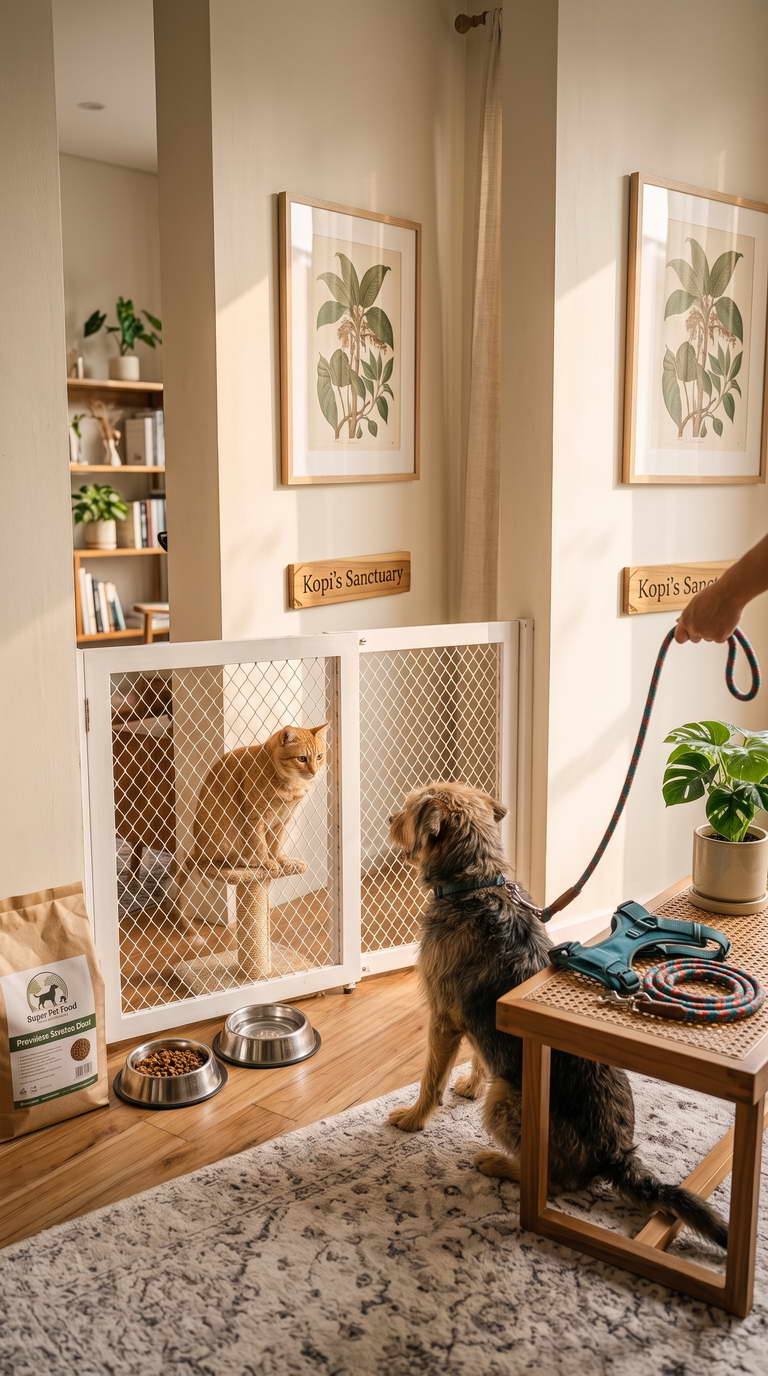
Install a tall, sturdy baby gate across a central doorway. If your dog is a jumper, stack two baby gates vertically, or use a cracked interior door secured with a heavy-duty door strap that lets them see each other through a four-inch gap.
-
Place the dog on a secure, 6-foot fixed leash held firmly by a handler sitting several feet back from the gate.
-
A second handler sits on the opposite side of the barrier with the cat, armed with savory treats.
       [Handler 1 with Leashed Dog] ─── 8 Feet Distance ───► [STURDY GATE] ◄─── 8 Feet Distance ─── [Handler 2 with Cat]
                                                                     ▲
                                                        Both animals fed treats
                                                       only while looking calmly!
The “Look and Dismiss” Exercise
-
Allow both animals to spot each other across the barrier for three seconds.
-
The instant your dog looks at the cat, say “Yes!” or click, then deliver a high-value piece of roasted chicken directly into the dog’s mouth, encouraging them to turn their head away from the gate.
-
Simultaneously, feed the cat a squeeze-treat treat while they observe the dog.
-
Repeat this exercise in brief, 5-minute sessions two to three times daily.
-
If the dog begins fixating (staring without blinking, trembling, whining, or barking), increase the distance immediately. Distance reduces arousal.
Phase 4: Controlled Leash Encounters in Open Space (Days 8 to 14)
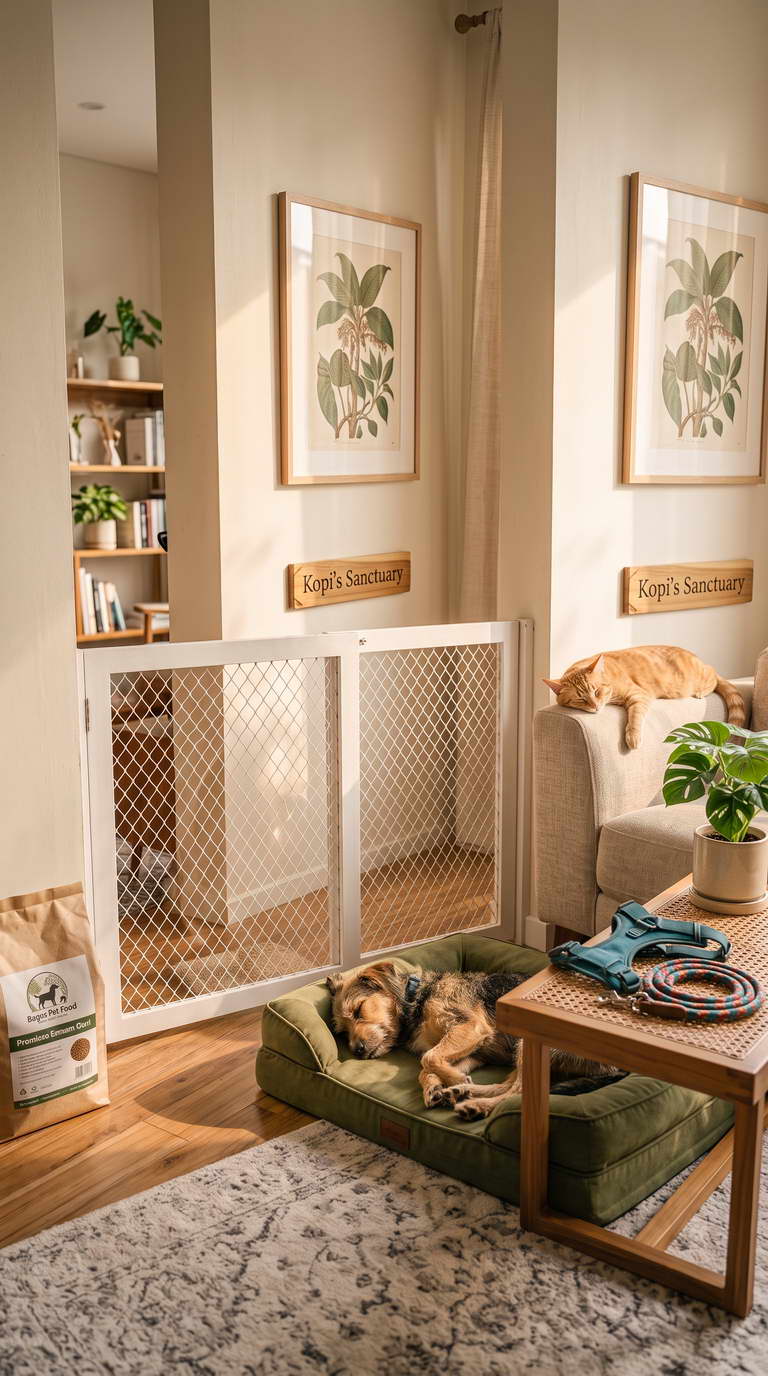
Once visual sessions at the gate are boring—meaning the dog glance at the cat and immediately turns around expecting a treat—you can remove the physical doorway barrier.
Non-Negotiable Safety Prerequisites:
-
The Cat Must Always Have an Escape Route: Ensure all interior doors to cat trees, tall tables, and the sanctuary room remain propped open. A cat that feels cornered will strike; a cat that can leap onto a 6-foot bookcase feels in control.
-
The Dog Stays on Leash: Never conduct early open-room meetings with an off-leash dog. Use a comfortable harness attached to a sturdy, non-retractable leash held by a calm adult handler.
-
Tire the Dog Out First: Conduct introductions only after your rescue dog has completed a brisk 45-minute walk or vigorous scent-tracking game in the yard. A physically tired dog has vastly superior impulse control.
The Controlled Interaction Routine
-
Have the dog lie down calmly beside your chair on a loose leash.
-
Allow the cat to enter the room voluntarily. Never pick up the cat and force them to approach the dog. Forcing a cat into a dog’s face induces sheer panic.
-
If the cat chooses to perch on the couch across the room, reward both animals with treats.
-
If your dog breaks eye contact with the cat to look at you when you call their name, reward generously with high-value treats. You are teaching your dog that ignoring the cat yields far greater rewards than fixating on them.
-
Keep these sessions short (10 to 15 minutes), ending on a positive note before either animal shows frustration.
Phase 5: Supervised Freedom and the Drag-Line Stage (Weeks 2 to 4)
When your rescue dog consistently demonstrates soft body language (loose wagging tail, relaxed open mouth, ignoring the cat’s movements) during leashed sessions, you can transition to supervised freedom.
The Drag Leash Protocol
-
Remove the leash from your hands, but leave a light, 6-foot nylon leash attached to the dog’s harness with the handle loop cut off (so it cannot catch on furniture).
-
Allow the dog to wander freely in the same room as the cat while you supervise actively from a few feet away.
-
If the cat suddenly dashes across the room and the dog twitches to chase, you can calmly step on the trailing leash line to halt the dog instantly without tackling them.
-
Continue rewarding the dog whenever the cat walks past and the dog remains seated or lying down.
Crucial Body Language: Green Flags vs. Dangerous Red Flags
Recognizing micro-signals in canine and feline posturing can prevent a serious injury.
Green Flags (Safe and Relaxed):
-
Dog: Soft blinking eyes, relaxed jaw with visible tongue, flexible curving spine, bowing playfully without stiffness, immediately disengaging from the cat when called.
-
Cat: Tail held upright or gently relaxed, slow blinks directed toward the dog, casually grooming paws in the dog’s presence, walking with a level back.
Red Flags (Separate Immediately):
-
Dog: Stiff, frozen posture; intense unblinking eye contact; raised hackles along the spine; whining or high-pitched barking while pawing forward; lowering head into a stalking position.
-
Cat: Ears pinned flat against the skull (“airplane ears”); low, rumbling growls; aggressive hissing; tail lashing violently back and forth; crouched posture with dilated pupils.
If you observe these red flags, call the dog’s name cheerfully, guide them away using a high-value treat lure, close the barrier, and drop back to the previous phase for two more days.
Golden Rules: What You Must NEVER Do
Well-meaning pet owners often make well-intentioned errors that set progress back weeks:
-
Never Let Them “Fight It Out”: Believing that a swat across the nose will “teach the dog a lesson” is dangerously mistaken. While some dogs back off, many high-drive dogs become retaliatory, turning a minor spat into a fatal attack.
-
Never Hold the Cat in Your Arms: If the dog jumps toward you, a panicked cat will instinctively climb you like a tree, shredding your arms, face, and chest with their claws.
-
Never Put the Cat in a Small Carrier on the Floor: Trapping a cat inside a crate while a dog sniffs frantically through the plastic grates terrifies the cat and builds frustrated arousal in the dog.
-
Never Lock the Cat Away Permanently: Remember, the cat was there first. If the cat feels evicted from their home because of the new dog, territorial frustration will manifest as spraying, inappropriate elimination outside the litter box, and chronic stress-induced illnesses like feline idiopathic cystitis.
When to Seek Professional Intervention
While most rescue dogs learn to respect cats, genetics play an undeniable role. According to pet behavior protocols outlined by the American Society for the Prevention of Cruelty to Animals (ASPCA), some canines possess predatory drives that are too intense to manage safely in a home with small animals.
Consult a certified professional dog trainer (CPDT-KA) or a board-certified veterinary behaviorist (DACVB) if:
-
Your dog cannot be distracted by high-value meat treats when a cat is in sight, even from 20 feet away.
-
The dog repeatedly exhibits predatory stalking behaviors (stiff freeze, dilated pupils, trembling, lunging).
-
The cat stops eating, hides for more than 48 hours consecutively, or exhibits severe urinary stress.
There is no shame in admitting when a specific rescue dog’s prey drive is incompatible with cat companionship. In rare cases, rehoming the rescue dog to an animal-free home is the most humane, loving choice for everyone involved.
Frequently Asked Questions (FAQ)
How long does it take for a rescue dog to adjust to a resident cat?
On average, a full, safe integration requires two to four weeks. Some easygoing dogs and bold cats co-exist peacefully in as little as ten days, while dogs with working heritage or shelter trauma may require two to three months of structured, slow desensitization.
What should I do if my rescue dog chases the cat?
Interrupt the chase immediately with an assertive verbal sound (like a sharp clapping sound), redirect the dog’s focus to a toy or high-value treat, and separate the animals. Do not punish the dog aggressively, as this increases their frustration. Step back to Phase 3 (visual barriers) and practice impulse-control games.
Are certain rescue dog breeds impossible to mix with cats?
No breed is impossible on an individual basis, but breeds with historically bred prey drives—such as Sighthounds (Greyhounds, Whippets), Terriers (Jack Russells, Pit Bulls), and Northern breeds (Huskies, Malamutes)—demand extreme caution and rigorous evaluation before cat exposure.
Can a cat and dog be left alone together unsupervised?
Never leave a newly adopted rescue dog and a resident cat alone together in the same open space for at least the first two to three months. Even when they appear harmonious, unexpected noises or sudden movements while you are away running errands can trigger instincts. Keep them separated behind closed doors whenever you leave the house.
Final Thoughts: Harmony Is Built on Patience
Learning how to introduce rescue dog to resident cat safely is not a race—it is an investment in your pets’ long-term peace and physical safety.
By respecting your cat’s territorial security, setting your rescue dog up for success with physical barriers and positive reinforcement, and following an unhurried desensitization protocol, you lay the groundwork for mutual respect.
In time, the tense standoffs and barrier gates will give way to soft naps on opposite ends of the couch, gentle mutual grooming, and a peaceful household where both four-legged companions feel completely secure in their forever home.
About The Author

Leave a Reply